

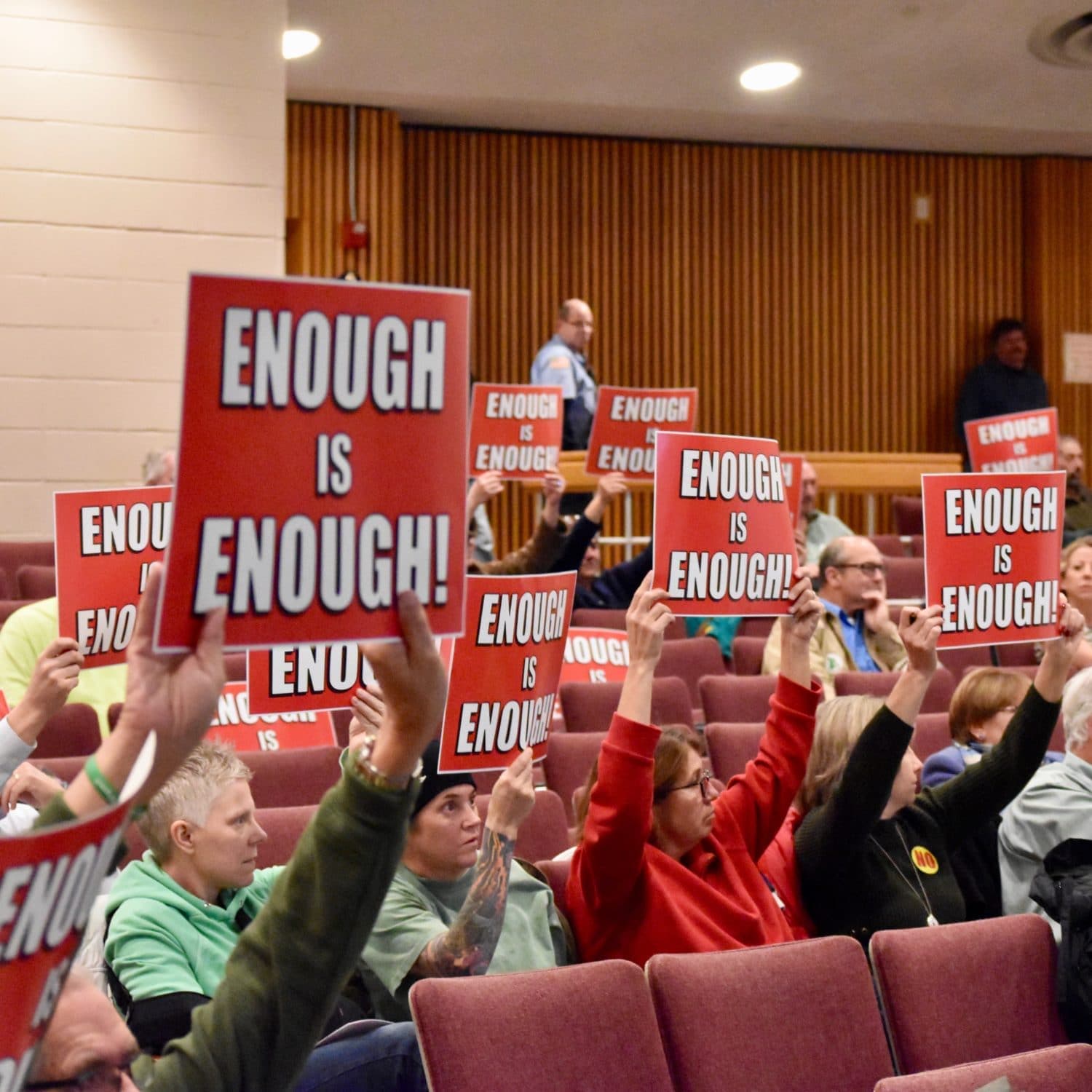
This has been a busy week in the Invenergy case, culminating in a Federal Energy regulatory Commission (FERC) ruling on Friday late afternoon in the second of the two pending lawsuits pertaining to Invenergy. This e-mail reviews the events of the past week, suggests what those events mean for opponents of Invenergy, and looks ahead to next steps.
On Monday, January 22, Invenergy informed the Energy Facilities Siting Board (EFSB) that it (Invenergy) had cancelled its water contract with the Narragansett Indian Tribe.
On Wednesday, Jan. 24, Invenergy informed the EFSB that it (Invenergy) had withdrawn its lawsuit at FERC seeking to shift hundreds of millions of dollars in interconnection costs to ratepayers.
Also on Wednesday, Conservation Law Foundation (CLF) asked the EFSB not to cancel the Show Cause Hearing schedule for next Tuesday, January 30, because there was still a very important second lawsuit pending at FERC that could affect the outcome of the EFSB Docket. We were unsuccessful; the EFSB cancelled the January 30 Show cause Hearing, saying that the hearing was moot due to the cancellation of the water contract with the Narragansett Indian Tribe and the withdrawal of one of the FERC cases.
Litigation always has its ups and downs, and the foregoing events were not helpful for the anti-Invenergy side. Invenergy’s filing its lawsuit at FERC, seeking to shift hundreds of millions of dollars in interconnection costs to ratepayers, was a very stupid move on Invenergy’s part for several reasons. It allowed CLF to hammer Invenergy mercilessly in the press, and it looked like the EFSB was going to stay the entire case until Invenergy’s lawsuit was resolved, which would have taken over a year. That delay would probably have killed Invenergy. Unfortunately, Invenergy recognized this fact as well as we did, which led Invenergy to withdraw its lawsuit. While this made Invenergy look “not yet ready for prime time,” it also makes a further stay unlikely.
Nevertheless, on Friday morning, CLF and Burrillville filed a motion for new stay (after a Show Cause Hearing) based on the continued pendency of the second lawsuit at FERC. In that Motion, we were pretty bold in asserting the likely outcome of the still-pending FERC case: ISO would win; Invenergy would lose. (Our prediction did not take much legal acumen. The standard of the Federal Power Act (Section 205) that the ISO had filed the case under is very, very, very deferential to the ISO.)
Also on Friday, the EFSB issued a schedule for the Final Hearing for dates running from April through August.
And, on Friday evening, FERC issued its ruling in the second case (and, yes, the ISO won, just as we said it would). (This is the technical, legal citation for FERC’s ruling: ISO New England, Inc. 162 FERC ¶ 61,058, Jan. 26, 2018.) Specifically, here is what FERC ruled:
- Invenergy lost its request to self-build the interconnection. [FERC Order, p. 16, ¶ 38.] Remember that Invenergy had said it could build the interconnection faster than National Grid could. But FERC ruled that Grid would build the interconnection. This means that it is now impossible for Invenergy to be operational on June 1, 2021, as it promised the EFSB. (This will hurt Invenergy if the case goes to a Final Hearing.)
- Invenergy also said it could build the interconnection less expensively than Grid could do, so there is now added expense for Invenergy. (Remember, these are the expenses that Invenergy had tried, but failed, to shift to ratepayers.)
- Invenergy lost its argument that it did not want to post the bond at the same time that it issues the Notice To Proceed (NTP) to National Grid (that is, proceed with designing and building the interconnection). [FERC Order, p. 10, ¶ 24.] Invenergy will have to post the bond when it issues the NTP, just as the ISO Tariff requires, just like every other generator in New England.
- FERC reminded everyone that Invenergy and National Grid are free to renegotiate the timing for signing the Large Generator Interconnection Agreement (LGIA) and posting the bond. [FERC Order, p. 10, ¶ 25.] (Invenergy and National Grid have already done this, because, under the original schedule, Invenergy should have signed the LGIA (and posted the bond) long ago.
- Invenergy conceived this project when Forward Capacity Auction (FCA) clearing prices (in FCA-8) were over $17/kW-month in this zone, and Invenergy hoped and planned to clear both of its turbines at that very high price. But by the time Invenergy participated in FCA-10, Invenergy was only able to clear one turbine and the auction clearing price had crashed to $7.03/kW-month (with no zonal price separation).
- Invenergy’s second turbine failed to clear again in FCA-11, and then was disqualified from even participating in FCA-12 (to be held on February 5, 2018). It is possible that the factors that led the ISO to disqualify Invenergy’s Turbine Two from FC-12 will also get the turbine disqualified for FC-13.
- There is little profit margin on the energy side of the market, and power plant developers rely heavily on capacity payments to turn a profit. The ISO provides a seven-year price lock for developers that clear in an FCA – but Invenergy has already lost three of those seven years.
- By withdrawing one of the two lawsuits at FERC last week, Invenergy is going to have to pay hundreds of millions of dollars in interconnection costs that it was not counting on paying.
- And with the FERC ruling on Friday, Invenergy lost its option to self-build the interconnection. Invenergy said that it could build the interconnection much faster and much less expensively than National Grid could. But now Invenergy is forced to pay the much higher costs of having Grid build the interconnection (and take longer into the bargain). Invenergy won’t be up and running in 2021, and it will lose a fourth year of the seven-year FCA price lock-in.
- If Invenergy doesn’t issue the NTP for eight to ten months, it won’t be on line until 2022 at the earliest. Invenergy will lose another year of its seven-year FCA price lock-in.
- If Invenergy isn’t up and running until 2022, it strengthens CLF’s argument that Invenergy wasn’t needed all along. Invenergy insisted that its electricity was urgently needed by the grid in 2019, but it is now obvious to everyone that Invenergy is not needed at all. This will hurt Invenergy at a Final Hearing.
- Moreover, lots more renewable energy is coming into the system every year, thereby lessening even further the need for Invenergy.
- In fact, it is entirely conceivable that the ISO will involuntarily terminate the Capacity Supply Obligation (CSO) that Invenergy acquired in FCA-10 as soon as it (the ISO) is able to do so under the Tariff, this summer (which would be before the end of the Final Hearing).