


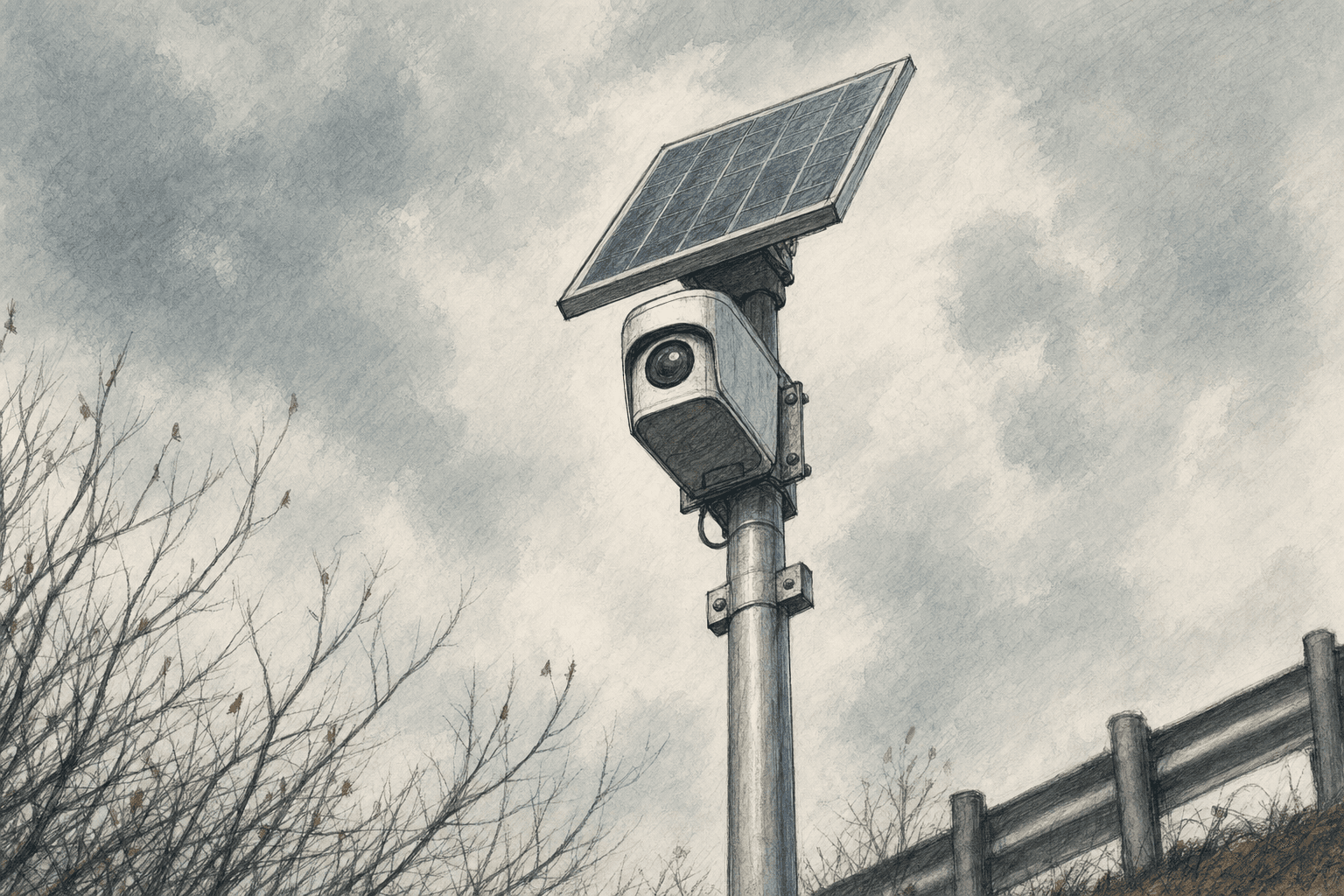
Twenty-two of them are already watching.
That is the state of Rhode Island's newest surveillance system as of July 30: 22 automatic license plate readers live on Rhode Island roads, out of 39 the Rhode Island State Police intend to install under a three-year, $597,000 contract with Flock Safety, the Atlanta company whose cameras photograph every vehicle that passes and hold the images in a searchable database. The first state police camera went up on June 25. The rest are coming.
And while that network fills in, the towns are pulling theirs out.
Local sponsorAffordable photography lessons in Newport, Jamestown, or your town.E.L. Photo RIOn Monday night the Narragansett Town Council voted unanimously to terminate its Flock contract — the second South County community to do so in eight days, following South Kingstown's unanimous vote on July 27 to cancel its own agreement and rip out the half-dozen automated license plate reader cameras already standing in town. South Kingstown's deal ran $30,300 a year for seven cameras, signed last July but not effectively live until the first pole-mounted unit went up in February. Little Compton's council rejected an installation request on June 4. Warren and Portsmouth turned down the state police outright when troopers came asking to put cameras on their streets, and both council presidents said the reason was residents' privacy — Portsmouth's Keith Hamilton and Warren's Joseph DePasquale each pointed to constituent objections rather than any dispute about whether the technology works.
Here's what makes the collision genuinely consequential rather than merely interesting: Rhode Island has no law governing any of this. None. Over a dozen states — including Vermont, Maine, New Hampshire, and Massachusetts, meaning we are ringed on every landward side by jurisdictions that have written rules — have enacted statutes regulating license plate readers. Bills to rein in ALPRs have been introduced and defeated in four consecutive General Assembly sessions, according to ACLU of Rhode Island policy associate Madalyn McGunagle. So the standards that exist are the ones each agency writes for itself, and they are not uniform: the default retention period on Flock's system is 30 days, but some departments purge in seven to fourteen days while others stretch to ninety. No warrant is required to run a search. Nobody gets notified. There is no opt-out.
The state police did put something on paper. General Order 80-G, issued January 16, sets out the agency's rules for ALPR use — a 30-day purge, trained operators only, audit trails on searches — and explicitly bars sharing data with federal immigration authorities. Captain Marc Alboum, who is running the deployment, has said the state agency will not share Flock data with other states or federal agencies at all. Providence, which operates the largest municipal network in Rhode Island, adopted its own prohibition on immigration-enforcement use of Flock data in October.
Those assurances are department-level, not statutory, and that's precisely the ACLU's point. The organization estimates at least 295 Flock cameras are operating in Rhode Island — an estimate, it concedes, because getting straight answers out of some police departments is difficult; the crowdsourced tracking site DeFlock lists 239. Barrington Chief Michael Correia, who presides over the Rhode Island Police Chiefs' Association, has put it more simply, saying more than half the state's police departments use the technology. Cameras arrived first in Woonsocket, Cranston and Pawtucket in 2021. Cranston has 29 active, the most of any municipality, and Cranston Col. Michael Winquist has credited them with 116 arrests since August 2021.
The strongest case for the cameras is not abstract. When Claudio Neves Valente killed two people at Brown University in December, Flock cameras in Providence had recorded 14 sightings of the suspect vehicle between December 1 and December 13, and the company additionally switched on artificial-intelligence features that were not part of Providence police's contract — including one that can re-identify a vehicle by description even if its plates have been swapped. Police chiefs across the state, Correia and Winquist among them, cite that investigation as the answer to privacy objections. It is also, read a second way, a demonstration that a private vendor can expand the capability of a public surveillance system in real time, on its own initiative, beyond what taxpayers bought.
Flock — founded in 2017, valued at $7.5 billion after a $275 million round last March backed by Andreessen Horowitz and the Peter Thiel-linked Founders Fund — sent government relations executive Trevor Chandler to South Kingstown's meeting, where he told councilors the company works with more than 40 municipalities and agencies in Rhode Island and over 7,000 law enforcement departments nationally. The council voted him down 5–0 anyway, after what one member called the biggest turnout the body had seen. Hundreds of letters of opposition came in, including one from the ACLU dated July 22.
At roughly $2,500 per camera per year, this is not the item that breaks a municipal budget; the cost is measured in something other than dollars. Which is the thing about a state 37 miles wide: stack enough of these on enough poles and every trip anyone takes — the commute, the clinic, the union hall, the Sunday drive to a cousin's house for a plate of macaroni — resolves into a timeline somebody can pull up in thirty seconds. Rhode Island's police departments are building that timeline agency by agency. Its towns are dismantling it town by town. And the General Assembly, four sessions running, has declined to say which of them is right.